
What I offer you
(Firmy z Polski zapraszam na strone/Companies based in Poland are invited to visit the website: IT-Consulting.pl)
What stage is your business at right now, and what stage do you want it to be at?
Level 0 – The company has no description of how it operates; knowledge is scattered amongst staff members; staff turnover results in significant losses; every change within the company incurs a huge cost
Level 1 – The company has a map and a description of key operational business processes and the flow of key documents; this is the minimum information required for investors and business partners, but any changes still come at a huge cost.
Level 2 – The company has a model of every operational process and procedure (e.g. ISO); however, the IT system remains a great mystery: its operational logic and information architecture are unclear, and the company suffers from a dependence on application suppliers.
Level 3 – The company has a documented, up-to-date model of its operations and key resources, and it documents and protects its know-how. Changes, new implementations and staff turnover are not a problem; they form a planned sequence of events.
System Auditing and Documentation
I am a business analyst and software engineer/designer based in Aberdeen, specialising in business process and systems modelling, IT architecture design, and technical documentation for organisations in the engineering sector (BPMN/UML/SysML).
Many companies are modernising systems, improving documentation, or preparing for audits and digital‑transformation projects. If you’re working on anything similar, I can help with:
- Mapping and improving existing system architecture
- Creating clear BPMN/UML/SysML models for teams and stakeholders
- Documenting processes, interfaces, and technical workflows
- Supporting legacy‑system modernisation or integration work
If it’s useful, I’m happy to offer a free mini‑review of one system or process and provide 2–3 practical recommendations. I also run training courses and workshops.

Are ERP implementations with independent architect supervision significantly less likely to fail?
It’s true – bringing in an independent architect into an ERP project is one of the best strategies for reducing risk. This person acts as a “fuse” between the business vision and the vendor’s technical capabilities.
Here’s why this approach dramatically increases your chances of success:
No conflict of interest : The independent expert is not compensated for license sales or developer hours. Their goal is to ensure system integrity, not to push a specific module.
Verifying supplier promises : The architect can distinguish standard functionality from costly modifications that are often the source of delays and errors.
Data Consistency (Master Data) : A common cause of ERP failure is data clutter. The architect oversees the information structure from the design stage, preventing system paralysis after launch.
Customization Oversight : Ensures the system does not become a “Frankenstein” of unrecoverable fixes, making future updates easier and lowering TCO (Total Cost of Ownership).
In short: the supplier implements the tool, but it is the architect who ensures that the tool actually supports business processes without generating technical debt .
How it works in reality:
Before selecting an ERP system and its supplier
I prepare companies for ERP system implementations and provide software vendors with complete documentation of customer needs. I design dedicated modules and applications and supervise their creation and implementation. I am on the customer’s side, guiding them through the entire implementation process and representing them in discussions with ERP vendors.
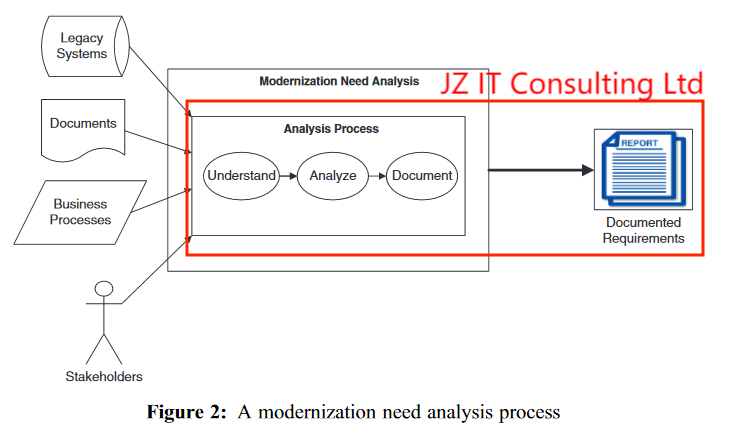
Small businesses, large corporations and public administration institutions in the EU have been using my services since 2004. I have been living in the UK since 2020. In 2026, I started providing these services as a Scottish company: my headquarters are located in Aberdeen, Scotland.
My products
- business process models,
- business logic as a business rulesmodel,
- documents, their content, ontology and connections,
- IT systems and integrations model,
- production systems models,
- software requirements specification as a model,
- all of the above as formally commented models using BPMN, UML, SysML,
- I supervise the implementation of designed systems: ERP and dedicated systems (external ownership).
The documentation I provide helps protect your company’s intellectual property and know-how. It is prepared in the same way as patent protection documentation.
My process
- We determine your project goal.
- You sent me the documents I requested.
- I analyse them and develop block diagrams and comments on them.
- You check, make comments, and we work together on the final version.
- You receive professional documentation and my support during the implementation of changes in processes and the implementation of the ERP system.
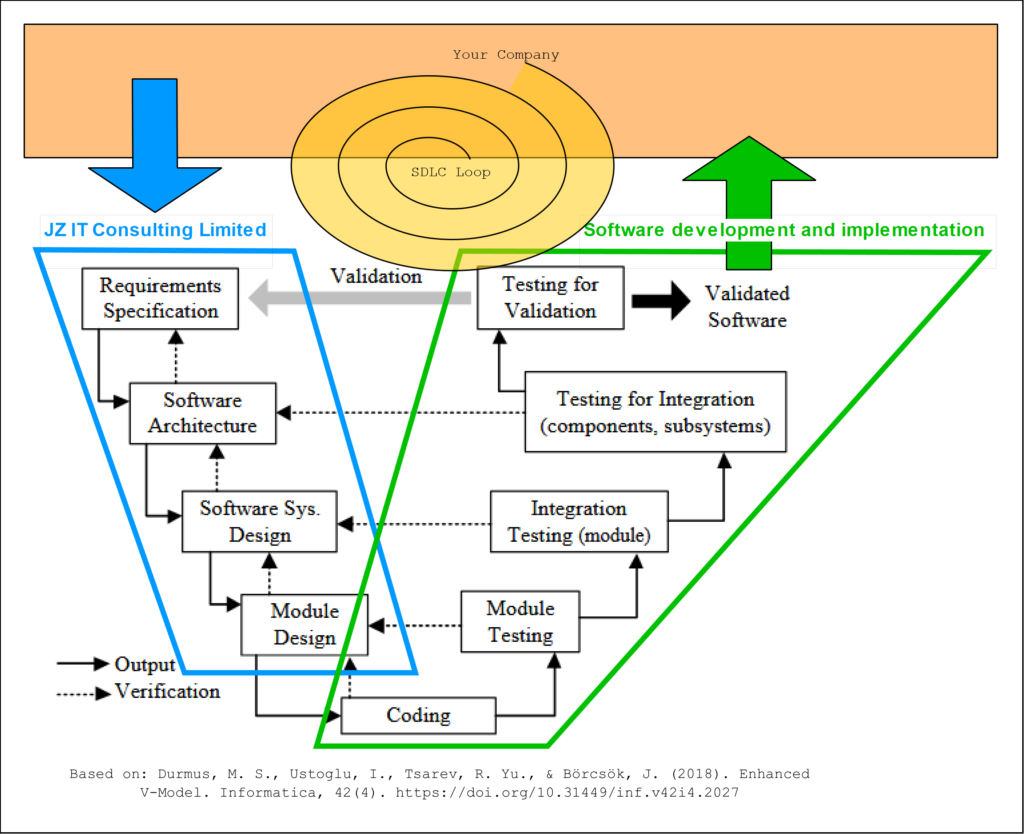
My role: Business Systems Solution Analysis & Design
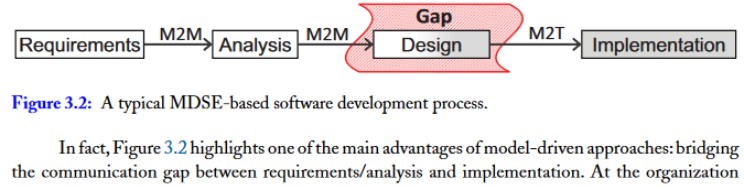
As a solutions designer, I fill this gap in projects.
—-
My rates
Standard daily rates (£500). Ask about a retainer contract: fill in the contact form.
Keywords: Enterprise Architect, Business Analyst, Design Authority, Solution Designer, Solutions Architect.