
Computerisation as an ontological project
Wprowadzenie

Modern organisations invest heavily in digitalisation, expecting IT systems to streamline processes, boost efficiency and enable better decision-making. The paradox, however, is that many of these projects end in disappointment: the systems fail to support the business, processes become rigid, and the organisation loses control over its own knowledge. The cause is not the technology, but a fundamental misunderstanding of the nature of organisational digitalisation projects.
Contrary to popular belief, digitalisation is not a programming endeavour. It is an ontological project, involving the modelling of an organisation’s reality, its concepts, relationships, principles and decision-making processes. Only on this basis can software be developed. Unfortunately, in practice, the order is reversed: it is developers – rather than analysts, knowledge architects and systems designers – who are responsible for defining the organisation’s semantics. It is worth noting here that numbers currently account for only a small fraction of the content being processed.
Ontology as the foundation of information systems

Every IT system is a concrete manifestation of a certain view of the world (see Plato’s Cave). It contains answers to the following questions:
– what constitutes a customer, a product, an order, a case, a document,
– what relationships between these entities are permissible,
– what rules govern their processing,
– what decisions can be made and on what basis?
These are not technical issues. They are matters relating to ontology, epistemology and knowledge management. An IT system is therefore nothing more than a formal model of an organisation, encoded in data structures, processes, rules and interactions. If the model is flawed, incomplete or haphazard, so too will the system be.
Why developers should not design organisational ontologies
Developers are experts in implementation, optimisation, integration and technical architecture. However, they are not – nor do they need to be – specialists in business semantics or conceptual modelling. Expecting a programmer to design an organisation’s ontology is like expecting a bricklayer to design a cathedral. A developer will build the walls, but will not design the house.
As a result, systems are created that reflect not the reality of the organisation, but the developer’s interpretation – often formed under the pressure of sprints, backlogs and time constraints. Data models are haphazard, processes are oversimplified, and business logic is hard-coded, making it impossible to understand or evolve.
Consequences: loss of control over the organisation’s knowledge
When an ontology isn’t deliberately designed, the organisation loses control over it. After a few years, nobody knows:
– why the system works the way it does,
– where the rules came from,
– how to change the process without rewriting half the application.
The system becomes a black box, and every change costs more and more. In extreme cases, the organisation starts to adapt to the system – rather than the other way round.
Model-Based Systems Engineering as an antidote
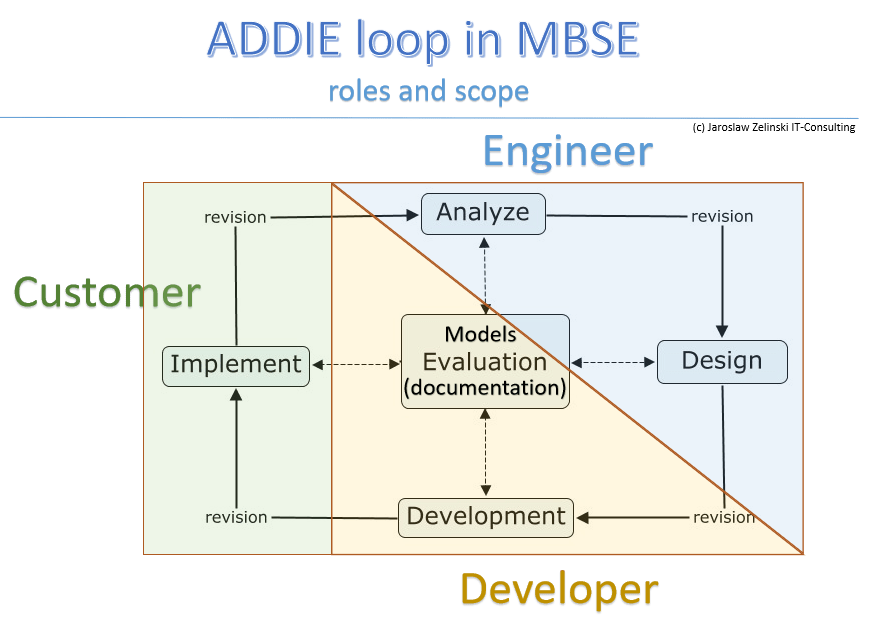
The solution is to return to principles that are self-evident in other fields of engineering: model first, implementation second. In practice, this means creating:
– a domain ontology,
– a conceptual model,
– a process model,
– a decision model,
– an information model,
– an interaction model.
Only on this basis can the logical and technical architecture and the implementation be designed. This is the essence of Model-Based Systems Engineering (MBSE) – an approach that enables organisations to regain control over their own knowledge and ensures consistency between reality and systems.Dopiero na tej podstawie można projektować architekturę logiczną, techniczną i implementację. To właśnie esencja Model-Based Systems Engineering (MBSE) – podejścia, które pozwala organizacjom odzyskać kontrolę nad własną wiedzą i zapewnia spójność między rzeczywistością a systemami.
The question that changes the conversation with the board
When working with management teams and clients, one question often proves crucial:
Do you want the system to reflect your organisation, or the developer’s interpretation?
This question gets to the heart of the matter and highlights the fact that digitalisation is not a technical task, but a strategic one. It requires organisational maturity, conscious modelling and skills that go far beyond programming.
Summary
Digitalisation is a process in which an organisation must first understand itself. IT systems are not merely technical tools, but structures of knowledge that can either strengthen an organisation or hold it back. A mature approach to digitalisation requires recognising that it is an ontological, epistemological and systemic project. Only then does technology become an ally rather than a source of frustration.